Our Blog

How do I know if I need braces?

December 18th, 2019

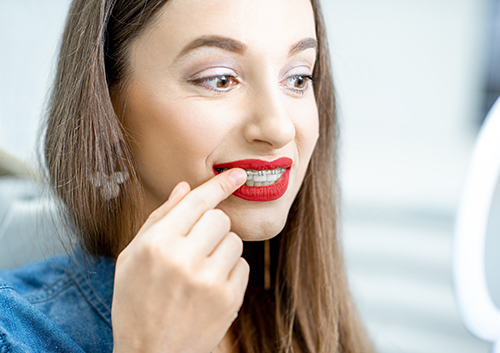
Perhaps you feel your teeth are not perfectly straight, or you think your bite could be adjusted. It’s quite possible that braces and other orthodontic treatments might be the right choice for you. As orthodontic professionals, our team at Hoybjerg Orthodontics works with your general dentist in order to determine the best options for your oral health and cosmetic appearance.

You might need braces if ...

  • You lost your baby teeth relatively early in life. If your baby teeth fell out too early and your adult teeth did not come in for a while, this could have affected the way your adult teeth grew and developed.
  • Your teeth look crowded or crooked. If you are embarrassed to smile because your teeth are not straight, it might be time to consider the cosmetic options available to you.
  • Your jaw shifts or makes sounds. This can signify a developmental issue with your teeth and your jaw line, and orthodontic treatment may be able to help. Set up an appointment with Dr. Adam Hoybjerg if your jaw is recessed or protruding as well.
  • You are constantly biting the sides of your cheek or hitting the roof of your mouth. This could indicate that your teeth are not properly aligned. Braces can address an underbite or an overbite.
  • You have a difficult time chewing your food. This is not only an inconvenience, but it can also be detrimental for your health. Braces can help fix the alignment of your teeth.
  • You have to breathe through your mouth on a regular basis. You may not attribute this to an issue with the development of your teeth or jaw, but orthodontic treatment might be able to help.

The ideal age for a child to be seen by an orthodontist is age seven. However, there are many orthodontic treatment options available to adults. It is becoming increasingly common for adults to wear braces and other orthodontic devices. We recommend that people who are interested in braces and other orthodontic treatment options set up a consultation appointment with Dr. Adam Hoybjerg today.

Orthodontics: From Tooth Fairy to Retainer

December 11th, 2019

You might be surprised to learn that Dr. Adam Hoybjerg and our team recommend an orthodontic appointment even before your child has had that last visit from the Tooth Fairy. In fact, orthodontic assessments at our Yuba City office can be beneficial at many stages of your child’s life. Let’s look at some of the reasons why.

The Right Spaces

There’s a reason why we recommend that every child see an orthodontist by the age of seven. If there’s room enough in your child’s mouth to accommodate all the permanent teeth that will be arriving soon, you’re good to go. But if it looks like there won’t be enough space for those adult teeth, there are solutions we can offer to make the transition from baby teeth to adult teeth a smoother one.

  • If your child’s mouth is small, the permanent teeth might have too little room to fit in when they arrive. We may recommend gently enlarging the upper dental arch with the use of a palatal expander. This device will provide room for the adult teeth, and could potentially shorten second phase treatment time.
  • Too much space can also be a problem. If a child loses a baby tooth too soon, too much space between the remaining teeth can cause them to shift out of position, leaving the wrong spot open for the adult tooth to come in. We might recommend a space maintainer so that there is no shifting of the teeth, and there is room for the adult tooth to erupt in its proper spot.
  • If there is a bite problem, early treatment can prevent more serious problems down the road.

If no treatment is necessary immediately, we can monitor the development of your child’s teeth and bite during periodic visits.

(Stay in) The Right Places

Once your child has achieved that perfect smile, it’s time to maintain it. Teeth actually move and shift throughout our lives, whether we have had orthodontic treatment or not. But with orthodontic treatment, the bone tissue and ligaments around the teeth remodel over time to hold the teeth in their new and improved positions. That’s why it’s often important to wear a retainer constantly for several months after the braces come off, as bone and ligament become a firm, strong anchor for the newly aligned teeth and bite.

But there’s no one expiration date on retainers! Worn nightly as needed, they help teeth stay securely in their new positions for a lifetime of beautiful smiles.

Healthy Smiles Mean Happy Faces

If you think your child is ready for any phase of orthodontic work, give us a call. We will be happy to make sure there is ample room for permanent teeth to erupt in their proper spots even during the baby teeth years. If braces are indicated at a later date, we will analyze any potential alignment and bite problems and present all of your treatment options. Finally, after the orthodontic work is completed, we want to make sure your child knows the best way to maintain that beautiful smile with conscientious retainer wear.

If you have any concerns about your child’s teeth or bite, even before the permanent teeth arrive, give our Yuba City office a call. Early treatment can often prevent future problems and might even lead to faster orthodontic results. At each stage of your child’s growth, we are here to provide your best options for healthy, happy smiles.

Avoid Brushing After Every Single Meal!

December 4th, 2019

Here is some surprising yet worthwhile advice you might be hearing for the first time: Brushing after a meal can be incredibly bad for your teeth if you do it after eating certain foods.

Enamel is an extremely hard mineral on the exterior of each of your teeth. It’s actually the hardest substance in the human body: It’s even stronger than your bones! Its only weakness is that acids in the food we eat can easily destroy enamel.

Healthy teeth thrive in an environment that has the proper pH balance. That ensures your mouth doesn’t start the process of demineralization. That’s what happens when alkaline turns into acid, which attacks and softens the enamel on the surface of your teeth. Pores and fissures form, and that’s when the harmful bacteria go to work.

Our mouth’s pH level fluctuates depending on what we eat throughout the day. Examples of the most common highly acidic foods include citrus fruits, soda, and sugary foods. Highly acidic foods tip the balance of pH in your mouth from a healthy alkaline to a dangerous acid.

Can brushing your teeth immediately after a meal lead to even more damage? The answer is yes!

Eating highly acidic foods causes your teeth to be more susceptible. If you brush your teeth when they have been weakened by acids, even more destruction can happen to your enamel. Your toothbrush’s bristles will actually wear away some of your enamel. So it’s healthier to wait at least an hour after eating or snacking to brush.

Good preventive measures to take instead of brushing after you eat include:

  • Rinsing or drinking water
  • Chewing sugarless gum
  • Consuming dairy or non-acidic foods to conclude your meal

These practices help produce saliva, which in turn restores a healthy pH level in your mouth and coats the teeth with minerals they need.

Once you’ve allowed time for your mouth to be restored to a healthy pH level, you may brush your teeth as you normally would. Keep in mind that acidic foods can weaken the enamel on your teeth and take the right measures to prevent spiking pH levels.

Most important, don’t forget to wait to brush at least one hour after you eat!

Still have questions? Call our Yuba City office and schedule an appointment with Dr. Adam Hoybjerg.

Thanksgiving

November 27th, 2019

At Hoybjerg Orthodontics, we love to celebrate the holidays with vigor! Dr. Adam Hoybjerg would love to share some unique ways of celebrating Thanksgiving from beyond the Yuba City area to the national level!

When Americans sit down to dinner on the last Thursday of November, the day that Abraham Lincoln designated as the day on which Thanksgiving would be celebrated, they do so thinking that the first Thanksgiving feast was held at Plymouth in 1621. According to National Geographic, the Spanish explorer Francisco Vásquez Coronado and his men celebrated a feast of Thanksgiving in Texas in 1541, giving Texas the distinction of being the first place where Thanksgiving was celebrated.

Different Types of Celebrations

Native Americans had rituals around which they celebrated in hopes of ensuring a bountiful harvest. The Cherokees had a Green Corn Dance that they did for this very purpose. The Pilgrims (not to be confused with the Puritans,) rejected any type of public religious display. They held a three-day long non-religious Thanksgiving feast. Although they said grace, the focus of their celebration was on feasting, drinking alcohol (they did have beer,) and playing games.

The Pilgrims at the Plymouth Plantation celebrated a different day of Thanksgiving in 1623. Plagued by a crop-destroying drought, the settlers prayed for relief. They even fasted. A few days later, they got the rain they so desperately needed. Soon thereafter, they received another blessing when Captain Miles Standish came with staples they couldn't otherwise get. He also told them that a Dutch supply ship was en route. In gratitude for the abundance of good fortune, the Plymouth settlers celebrated a day of prayer and Thanksgiving on June 30, 1623.

The Story of Squanto

No discussion of Thanksgiving is complete without a discussion of Squanto, or Tisquantum, as he was known among his people, the Patuxet Indians. It is believed that he was born sometime around 1580. As he returned to his village after a long journey, he and several other Native Americans were kidnapped by Jamestown colonist, Thomas Hunt. Hunt put them on a ship heading to Spain where they were to be sold into slavery.

As fate would have it, some local friars rescued him and many of the other kidnapped natives. Squanto was educated by the friars. Eventually, after asking for freedom so he could return to North America, he ended up in London where he spent time working as a ship builder. By 1619, he was finally able to get passage on a ship headed to New England with other Pilgrims.

Upon arriving at Plymouth Rock, he learned that his entire tribe was wiped out by diseases that accompanied earlier settlers from Europe. In gratitude for passage on their ship, he helped them set up a settlement on the very land where his people once lived. They called the settlement Plymouth. Since they knew nothing about how to survive, let alone how to find food, Squanto taught them everything, from how to plant corn and other crops, how to fertilize them, how and where to get fish and eels and much more.

After a devastating winter during which many settlers died, thanks to Squanto's teaching, they had an abundant harvest. After that harvest, they honored him with a feast. It is this feast of 1621 which was celebrated between the Pilgrims and Wampanoag Indians that is widely considered the first Thanksgiving celebration.

About the Meal of the Plymouth Settlers

Surviving journals of Edward Winslow that are housed at Plymouth Plantation indicate that the first Thanksgiving feast was nothing like what Americans eat today. The meal consisted of venison, various types of wild fowl (including wild turkey,) and Indian corn. There were no cranberries, stuffing, pumpkin pie, potatoes, or any of the other “traditional” foods that appear on modern menus.

Today, Thanksgiving is celebrated on the fourth Thursday of November, the day that Abraham Lincoln designated as the holiday. It is still a day of feasting, and for some, a day of prayer and thanksgiving. For others, it is a celebration of gathering, especially for families. Still others may celebrate in entirely different ways, including watching college football bowl games, or by playing family games.

If you ever wonder why you're so tired after the Thanksgiving meal, it's because turkey contains an amino acid, tryptophan, and it sets off chemicals whose chain reaction combine to make people sleepy.

50

Advanced Degrees

50

Locations

50

Name on the door